 Magyarul / Hungarian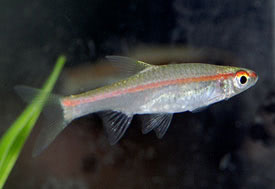
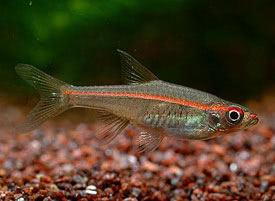
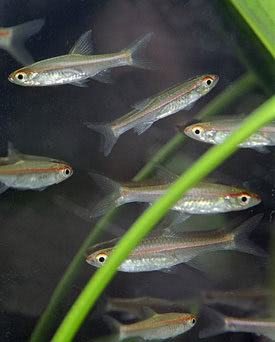
- Scientific name: Trigonopoma pauciperforatum
- Synonyms: Rasbora pauciperforata
- Common name: Red-line rasbora
- Group: Cyprinids
- Habitat: Southeast Asia; Malaysia, Sumatra.
- Size: 5 cm
- Biotope: Found in still to slow-moving, blackwater streams and creeks that have overhangingand overgrown vegetation
- Social behavior: A peaceful, schooling fish of the upper and middle swimming levels. Combine with similarly sized, activeschooling fishes.
- Diet :Live, Drosophila, insects, Tubifex, crustaceans, insect larvae flakes.
- Breeding: Very difficult
- Tank: Minimum 80 litres
- Population: 6-8 fish for 80 litres
- Decoration: A cover of floating plants along with a dark substrate are recommended. Plant the tank heavily, but leave someopen swimming areas at the middle and top levels.Peat filtration is suggested.
- Temperature: 22-27 °C
- pH: 6-6.5
- Hardness: 2,8-5,6NK°
- Lifespan: 3-5 years
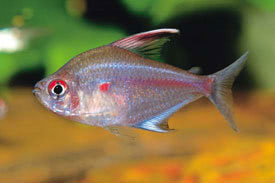
Description: An elongated fish with a forked tail. The back is olive brown and the bodyis brownish-gray.The belly is white.The fins are all smoky-gray. Under favorable conditions, fish developa bright red stripe that runs from the tip of he snout, through the upper part of the iris, and to the caudal fin.
Females are plumper especially around spawning times.
Use water with a pH from 5.5-6.0, a water hardness from 2-3 dH, and a temperature from79-84°F (26-29°C).Plant the tank heavily with fine leafed and grassy plants. Pairs are very selective about theirpartners.Try keeping a large number of fish in a school, and watch for similar pairs. The eggs are scattered among these plantsand hatch after 24-28 hours.The fry are free-swimming 3-5 days later and can be fed with Infusoria, roftiers, and liquid foods. Theyoung are sensitive to changes in water changes.